Often, Lead Acid Forklift / Traction type Batteries intended for the Motive Power Energy industry are used as high-capacity storage Batteries in the Solar PV and Hybrid Inverter industry. These are typically made up of 24x 2V Flooded Lead Acid Cells connected in Series to create a 48V large capacity Lead Acid Storage Battery Bank. These Battery Banks are typically around 1000Ah Capacity and can be connected in parallel with additional Battery Banks to create an even larger capacity Storage Battery Bank.
During a Charging Cycle or a Discharge Cycle the DC Voltage of the Batteries can be inadvertently affected such that their actual Voltage reading can be temporarily enhanced or reduced. As a Battery Charge is initiated so the Battery Voltage increases a few Volts due to the Battery Charging Voltage. Similarly, as the Battery is discharging to support a Load so the actual Voltage can be reduced because of the Load Demand. These effects can therefore make it difficult to be able to set accurate AGM Voltage Setting Values to correctly charge such AGM Lead Acid Battery Banks
As FYI, and as a guide please see below information which was provided to Sunsynk Technical Support by a Technical Support Manager of a Forklift Batteries supplier...
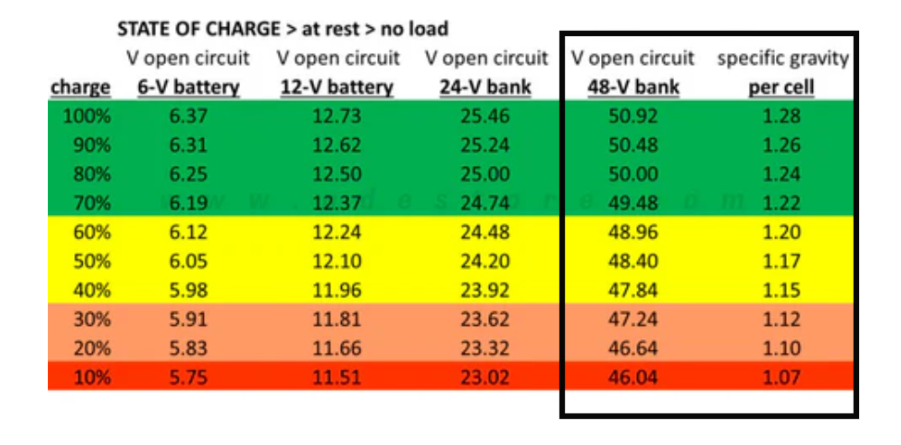
Absorption Charge is when bulk charging is nearing completion generally around 80 to 90% charged, we would expect voltage readings to be around 2.09-2.10 volts per cell, with Specific Gravity readings around 1.260-1.280
Equalization Voltage would be end of charge voltage generally around 2.15 to 2.17 volts per cell. Equalisation charging is recommended every 60 to 90 days to eliminate voltages becoming out of sync.
Equalization Charge in days as above.
Equalization Period in hrs, our application (forklifts) the Equalisation charge period would typically be around 10 to 12hrs.
Float Charge / Trickle Charge generally after Absorption charge, when the charge current reduces & the SOC would be around 98%
Voltage at 80% DOD would be around 2.03 Volts per cell, with SG readings around 1.200
Voltage for a low battery condition no lower than 1.99 Volts per cell, with SG readings around 1.170
Voltage when battery is considered empty 1.96 Volts per cell, with SG readings around 1.150
Gassing Voltage is around 2.35 Volts per cell; this is a critical voltage reading to ensure the battery starts the gassing process when the Electrolyte starts to mix.
TOC (Top of charge voltage) would need to be around 2.60 Volts per cell minimum to ensure that battery has gone through the gassing stage/phase.
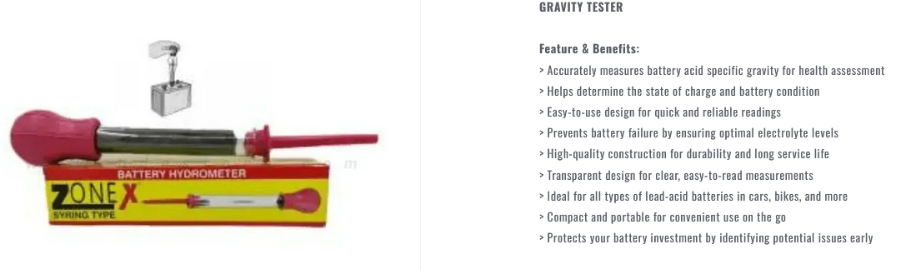
We would also recommend regular Specific Gravity (SG) readings are taken using a Hydrometer.
Below is a Chart of Battery Voltage vs Specific Gravity per Cell from a website forum on this topic and the 48V Battery Bank information has been emphasised.
Below is a typical Hydrometer as can be used to check Specific Gravity (SG) Readings of the electrolyte inside the Battery Cells and hence more accurately determine the State of Charge and Battery Condition as per the Features and Benefits listed. This example is extracted from the NDE Store website (www.ndestore.com)
Was this article helpful?
That’s Great!
Thank you for your feedback
Sorry! We couldn't be helpful
Thank you for your feedback
Feedback sent
We appreciate your effort and will try to fix the article